
Stairs
to Bliss - by
Imam Shurunbulali (rahmatullahi alaihi)
The
Book of Taharah - The Acts Which Break Wudu
Explication
by Shaykh Husain:  Real Audio: Listen
Online | Download
Real Audio: Listen
Online | Download
Translation
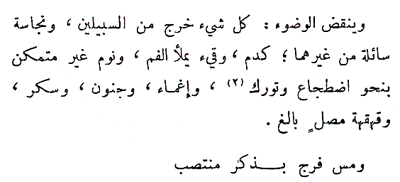
The nullifiers of wudu include:
1) anything which exits from the two paths (i.e. the urinary tract and
the anal tract),
2) an impurity which exits from any part of the body for example blood
(from a wound) or a mouthful of vomit
3) sleep in which the buttocks are not firmly planted on the ground, for
example lying on one's side or sitting with one's heels on the floor and
knees against the chest
4) fainting
5) temporary states of insanity
6) intoxication
7) laughing out loud during prayer
8) touching of an erect male private part with a woman's private part
(without insertion)
Commentary
These acts nullify the wudu and enter an individual into a state of minor
ritual impurity. The general principle here is that any type of impurity
that exits from the body nullifies the wudu. This includes a mouthful
of vomit, gas or stool from the rectal tract, urine or light seminal fluid
from the urinary tract, and blood or pus from anywhere on the body. Of
note is that blood or pus that remain on the border of a wound, without
flowing over, does not break the wudu. Furthermore, anything (whether
or not an impurity) that exits from the rectal or urinary tract nullifies
the wudu.
Hypothetical Case: A person who is pricked with a pin or who experiences a paper cut such that blood does not flow beyond the border of the wound retains his state of wudu.
Hypothetical Case: If a person inserts his finger into his nose and removes it to reveal a stain of blood on his finger that does not flow, then the wudu is not nullified.
Hypothetical Case: Squeezing a boil or pimple such that blood or pus flows from it nullifies the wudu.
Hypothetical Case: If blood oozes from a wound and is repeatedly dabbed with a cloth then one should contemplate whether or not the blood would have actually flowed from the wound had it not been dabbed. If so, then the wudu is nullified.
Hypothetical Case: An individual notices blood in his saliva after brushing his teeth. If the blood is equal to or more than the saliva, and the saliva is red in color, then the wudu breaks.
Hypothetical Case: A mouthful of vomit breaks the wudu. If it is less than a mouthful, the wudu remains intact. If a person vomits phlegm only, irrespective of the amount, the wudu does not break. If a blood which is thin and flowing is present in the vomit then the wudu is nullified even if the vomit is less than a mouthful.
Hypothetical Case: The flow of tears from painful, pink eyes breaks the wudu.
Hypothetical Case: A medical device that enters the rectal tract (for example a colon scope) or urinary tract (for example a Folley catheter) renders the wudu invalid upon its removal.
Deep sleep and fainting invalidate the wudu because of the likelihood of wind passing from the rectum as it sphincter relaxes. Deep sleep is defined as that which occurs while lying down or reclining such that were support removed the person would fall. Insanity and intoxication are included because of the loss of awareness as to whether or not wind may have passed.
Hypothetical Case: If a person falls asleep while sitting or standing in prayer, his wudu will not break. If he falls asleep while in prostration, his wudu breaks.
Hypothetical Case: If a person falls asleep with his buttocks firmly planted on the floor, with reclining against something, he wudu does not break.
Hypothetical Case: If a person sways from side to side while sitting, without falling, then his wudu does not break.
Spiritual Dimension: Note the inclusion of intoxication in this list. The scholars of fiqh were careful not to exclude those who posses habits which might contradict other tenants of Islamic law. The errors such people commit do not remove them from the fold of Islam. Thus, the shari'ah remains applicable in their lives.
The enormous grace of Allah (subhanahu wa ta'ala) prohibits His unveiling of many of our realities. When a weakness of a member of our community is exposed, we should be quick to conceal it and make excuses. Each of us has deep-rooted bad habits. Allah (subhanahu wa ta'ala) exposes these characteristics in some, while for others they remain hidden. None of us knows who sheds a tear of repentance in solitude. We seek His Infinite Mercy, and ask that he conceal our faults in both this world and the hereafter.
The seventh nullifier of wudu is laughing in prayer. This not only invalidates the wudu, but the prayer as well. If such laughter occurs in a funeral prayer, neither the wudu nor the prayer are invalidated. Laughter is defined as that which is loud enough for someone else to hear.
The final act that breaks wudu is the touching of an erect male private part with a woman's private part. This assumes that no barrier or cloth is present between these parts. If this progresses to insertion, a ritual bath becomes mandatory on both the man and the woman.
Hypothetical
Case: Seeing one's own private part, or that of someone else, does
not break the wudu.
Explication
by Shaykh Husain:
Real Audio: Listen
Online | Download
 If
you have any questions on the material covered above, please feel free
to Contact
Us and we will respond shortly.
If
you have any questions on the material covered above, please feel free
to Contact
Us and we will respond shortly.