
Stairs
to Bliss - by
Imam Shurunbulali (rahmatullahi alaihi)
The
Book of Taharah - Concerning Water
Explication by Shaykh Husain:  Real Audio: Listen
Online | Download
Real Audio: Listen
Online | Download
Translation
Purification
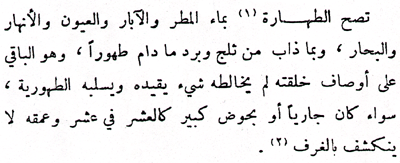
is attained using rainwater, well water, spring water, river water, seawater,
and melted water from snow and hail, so long as these remain pure and
purifying. This water must retain the characteristics upon which it was
created (i.e. its color, taste, and odor) such that something does not
mix with the water restricting it (from purifying) or rendering it impure.
This description also applies to flowing water (e.g. of a river) or extensive
water (e.g. standing water present in a large reservoir whose length and
width are 10 arm lengths each and whose depth is such that were a handful
of water taken, its floor would not be exposed).
Commentary
Allah says in the Qur'an, "We have descended from the sky water which
is pure and purifying." [Chapter 25, Verse 48] Based on this verse,
rainwater is both pure and purifying. Pure implies that if such water
falls on an individual's clothing the cloth remains pure, and purifying
implies that such water may be used to purify another object, for example,
a piece of urine soiled cloth. Because rainwater is the source of water
present in springs, lakes, rivers, oceans, and wells, these types of water
are also both pure and purifying. Thus they can be used for purification
as well.
The question arises whether water which is altered, for example, a bucket in which a drop of urine falls, can be used for purification. To answer this question, the jurists searched the treasury of the hadith of the Prophet (saw) and found two types of narrations.
The first category establishes that a single drop of impurity in a vessel of water renders it impure. For example, the Messenger (saw) stated, "When one of you wakes from his sleep, he should wash his hands before he enters them into the vessel because he knows not where his hands slept." During the time of the Prophet (saw), stones (without water) were sometimes used for purification after relieving oneself. While this is permissible within the shari'ah, it was possible that one's hands might come in contact with molecules of residual impurity, especially on a hot summer night when such impurities could dissolve in sweat. Thus the Prophet (saw) advised his Companions to wash their hands before placing them in the vessel for wudu (ablution). This narration highlights that even a single drop of impurity renders a small vessel of water impure.
The second category of narrations establish that water has three essential characteristics and that one of these must be overcome by an impurity before the water is rendered impure. This applies to larger, abundant bodies of water and to flowing water such as rivers. For example, the Prophet (saw) stated, "Water, nothing renders it impure, except that which overcomes it color, taste, or smell."
This narration applies to both large abundant bodies of water and the flowing water of streams and rivers. So, the question arises, when is water classified as abundant. Initially Imam Abu Hanifa left this open to individual discretion. He felt that each individual could best ascertain what constituted abundant water (for example a large pond) and what constituted limited water (for example a bucket). However, on one occasion the students of Imam Muhammad persisted in questioning their teacher concerning the amount required to classify water as abundant. He replied that any amount greater than that present in the basin outside of the masjid where he conducted his lessons would constitute abundant water. His students then measured the basin and found that it was ten arm-lengths in length and width, and deep enough that removal of a handful did not reveal the floor of the basin. This later became the famous "ten by ten" definition of abundant water of the Hanafi legal school.
The Shafa'i school defines abundant water as that greater than two qillah (a large unit of measure) based on certain narrations of the Prophet (saw). While the Hanafi jurists reject the usage of these narrations for several reasons, a famous scholar in India once constructed a "ten by ten" basin and found that it approximated the amount of water held within two qillah. This amount was slightly over 200 liters.
Returning to the second category, the Prophet (saw) stated, "Water, nothing renders it impure, except that which overcomes it color, taste, or smell." Again, this applies to abundant water (greater than 200L) and establishes that such a large amount of water is not rendered impure until a change in color, taste, or smell is produced. If the impurity alters a single characteristic, the abundant water becomes impure.
Scenario - An animal is slaughtered at the edge of a river upstream of a campsite. Preparing to make wudu, a person notices that the color of the water turns red. At this point he cannot use the water to make wudu because one of the three essential characteristics of water, namely color, has been changed by an impure substance (blood). The camper may use this water only after the original color of the water returns.
Scenario - On a daily basis large amounts of waste, sewage, and excrement are dumped in lakes. This does not render the water impure because even this amount of impurity does not alter the color, smell, or taste of the lake. Thus, lake water can be used for purification.
Scenario - A washing machine holds much less than 200 liters of water. However, it is used on a daily basis to purify impurities from clothing. This is acceptable because the scholars equate the input and output of the washing machine with flowing water. Thus it is permissible to use a washing machine to purify clothing. However, if an article of clothing is so soiled that a single characteristic of the released water is altered, then the clothing will not become pure. The machine must be run a second time such that clean water is spun from the machine.
Spiritual
Dimension - Despite the tons of impurity released into the ocean,
for example the excrement of animals and waste products of man, its water
remains pure. Although present, the molecules of impurity are overlooked
because of the extensiveness of the water. As a corollary, indeed marvelous
are the teachings of our beloved Messenger (saw) who taught us to overlook
the molecules of others imperfections when present in the ocean of their
iman. Further, we hope that the Magnificent Lord (swt) who commanded
us to overlook these impurities will Himself overlook the imperfections
present within the heart of His striving servants.
Explication
by Shaykh Husain:
Real Audio: Listen
Online | Download
 If
you have any questions on the material covered above, please feel free
to Contact
Us and we will respond shortly.
If
you have any questions on the material covered above, please feel free
to Contact
Us and we will respond shortly.