
Stairs
to Bliss - by
Imam Shurunbulali (rahmatullahi alaihi)
The
Book of Taharah - Etiquettes of Wudu
Explication
by Shaykh Husain:  Real Audio: Listen
Online | Download
Real Audio: Listen
Online | Download
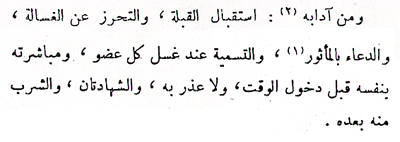
Translation
From its etiquettes are:
1) facing
the direction of the qiblah (Makkah)
2) taking caution to avoid being splashed with used water
3) reciting the narrated supplication of wudu
4) saying bismillah when washing each body part
5) performing the wudu before the time of prayer when no excuse is present
for delay
6) reciting the two testifications
7) drinking from the unused water after completing the wudu
Commentary
In this section the author lists some of the etiquettes of wudu. These
are classified as mustahab, or desirable. While performing them is rewarded,
leaving them is not blameworthy.
The first of the etiquettes is facing the direction of the qiblah. The qiblah is the focal point for the life of a Muslim and according to the mashaikh it is the central point upon which the blessings and nur of Allah (swt) descend. Within the shariah, the qiblah is given special importance. For example, it must be faced when performing the prayer and, on the other hand, it is highly disliked to relieve oneself when facing it.
Spiritual Dimension: Imam al-Zarnuji relates in his Instruction of the Student, "It is reported that two men went abroad seeking knowledge and were companions in learning. After some time, they returned. One had developed deep understanding, the other had not. The jurists of the land pondered [this matter] and investigated their situations, their method of retaining their lessons, and how they sat when studying. They were informed that the one who had mastered sacred law had sat in a certain way, while he often repeated what he had learned; he also faced the qiblah and the city in which he had gathered his knowledge. However, the other man had turned his back to the qiblah and [turned] his face away from this city. So these theologians and legalists agreed that a jurist masters the study of law [in part] through the blessings of turning in the direction of the qiblah, since this is the traditional way of sitting except under compulsion to do otherwise.
The second of these is to avoid being splashed with water already used to wash the body parts in wudu. The water which is used to wash each body part while performing wudu carries away the sins associated with the that limb. This was described by Abu Hurayrah (ra) when he related that the Prophet (saw) said, "When a Muslim or a believer makes his wudu and washes his face, the water carries away all the sins committed by his eyes, and when he washes his hands, the water removes sins committed by his hands, and when he washes his feet, the water washes away the sins towards which his feet had taken him, and he emerges cleansed of all his (minor) sins." Given these unseen impurities, it behooves the seeker to avoid splashes of used water.
The third
is reciting the supplication prescribed by the Prophet (saw) after performing
wudu. Umar bin Khattab (ra) related that the Prophet (saw) said, "When
one of you performs his wudu carefully and then states the following,
he will find all the eight gates of paradise open for him and he can enter
by any gate he likes,
I testify that there is no deity worthy of worship except Allah (swt), alone, without a partner, and I testify that Muhammad (saw) is His servant and Messenger.
O Allah (swt), make me from among the oft repenting and make me from the pure."
The fourth of the etiquettes is reciting the bismillah before washing each individual body part. Washing each limb as an independent act of worship. Every act of wudu is either commanded by the Qur'an or established by the Messenger (saw), and therefore each individual act is independently great. Furthermore, the purification from minor sins achieved as each part is washed emphasizes the need to focus on each individual act.
The fifth involves performing the wudu before the actual time of prayer begins. This highlights the role of wudu as a key to prayer and demonstrates an individual's eagerness towards the upcoming prayer.
The sixth involves reciting the two testifications of faith after completing the wudu. This was discussed earlier. Although not mentioned in this particular text, it is also preferable to pray two superogatory rak'ah after completing the wudu. This is termed tahiyyah al-wudu. The Prophet (saw) once asked Bilal (ra), "Which of your acts is most auspicious since your entering Islam? Verily I have heard the sounds of your shoes in jannah." He replied, I have not performed a more auspicious act than my offering what Allah (swt) has destined for me from prayer after I purify myself."
The final
etiquette is drinking the water from which the wudu is performed. This
can be done from the faucet when wudu is performed at a sink.
Explication
by Shaykh Husain:
Real Audio: Listen
Online | Download
 If
you have any questions on the material covered above, please feel free
to Contact
Us and we will respond shortly.
If
you have any questions on the material covered above, please feel free
to Contact
Us and we will respond shortly.