
Stairs
to Bliss - by
Imam Shurunbulali (rahmatullahi alaihi)
The
Book of Taharah - Requisites of Wudu
Explication
by Shaykh Husain:  Real Audio: Listen
Online | Download
Real Audio: Listen
Online | Download
Translation
The
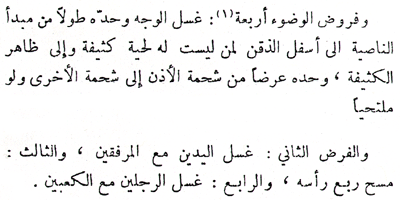
necessary requisites (faraid) of wudu are four:
1) washing the face (once). The face is defined in length by the area
between the top of the forehead to the bottom of the chin for one who
does not have a thick beard and to the outer surface of the beard (for
one who has a thick beard). In width, the face is defined as the area
between the two earlobes irrespective of the beard.
2) washing the arms with the elbows (once)
3) wiping one-fourth of the head (once)
4) washing both feet with the ankles (once)
Commentary
Just as physical substances assume states of purity and impurity, the
body also assumes one of three states; taharahh (purity), al-hadth al-asghar
(minor ritual impurity), and al-hadth al-akbar (major ritual impurity).
Minor ritual impurity is the state entered by the nullifiers of wudu and
major ritual impurity is that state which necessities a legal bath. This
section deals with removing the state of minor ritual impurity.
Allah (swt)
states, "O you who believe, when you stand for prayers wash (once)
your faces, your arms to the elbows, and wipe (once) your heads, and wash
(once) your feet to the ankles." (Chapter 5, Verse 6)
This verse of the Holy Qur'an establishes the four fard (required) acts
of wudu. Omission of any of these integrals renders the wudu invalid.
According to the Hanafi jurists, only a definite command from a definite
source can establish an act as fard. The definite sources for the Hanafis
are the Quran, the ahadith mutawatirah, and ijma'. Here a definite source,
the Qur'an, commands a series of actions, making them fard.
Leaving a fard is a sin, while denying a fard is an act of disbelief. That is, someone who doesn't perform wudu is a sinner, however, if someone outright denies wudu as part of Islam, he in essence has denied a verse of the Qur'an and therefore, enters a state of disbelief (kufr).
The first of these integrals is washing the face once (once is fard while three times is sunnah). The face is defined linguistically as that area which is seen when facing someone. This includes the area between the earlobes in width and from the top of the forehead to bottom of the chin in length. For those areas of the face covered with hair such that the underlying skin is not visible, washing the overlying hair suffices. This includes eyebrows and the hair of a thick beard. If the beard is so thin that the underlying skin is visible, then the skin must be washed when making wudu.
The second of the integrals is washing the arms to the elbows once. This includes the beginning of the fingertips to the elbow.
Hypothetical Case: Special care should be taken when wearing nail polish as its creates a water resistant film which prohibits water from reaching the mandatory surfaces of the finger nails.
The third
is wiping one-fourth of the area of the head once. The grammatical construction
of the verse of wudu implies that wiping the entire head is not mandatory.
Furthermore, the Prophet (saw) wiped as little as the front of his scalp
(approximately one-fourth of his head) on occasion. Thus, because the
Prophet (saw) would never leave a fard, the minimal area of the head which
must be wiped is one-fourth. Wiping of the entire head is sunnah.
The final required act of wudu is washing the feet including the ankles.
Again, washing once is required while washing three times is sunnah. Special
care should be taken when washing the posterior side of the ankles as
this area is easily missed. Once, when his companions were hurriedly making
ablution, the Prophet (saw) stated, "Woe to the heals, save them
from the hell fire."
Note that
each of the above four acts is required only once. Washing any body part
three times is considered sunnah. This is established by the fact that
the Qur'an makes a single command, which in turn, can be fulfilled by
a single washing of each body part listed. This is further supported by
the narration of Abdullah ibn Abbas that the Prophet (saw) made wudu (on
occasion) washing each body part only once.
Explication
by Shaykh Husain:
Real Audio: Listen
Online | Download
 If
you have any questions on the material covered above, please feel free
to Contact
Us and we will respond shortly.
If
you have any questions on the material covered above, please feel free
to Contact
Us and we will respond shortly.