
Stairs
to Bliss - by
Imam Shurunbulali (rahmatullahi alaihi)
The
Book of Taharah - Conditions for Being Responsible for Wudu
Explication
by Shaykh Husain:  Real Audio: Listen
Online | Download
Real Audio: Listen
Online | Download
Translation
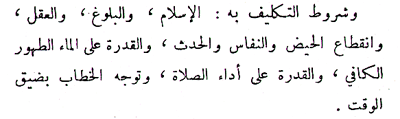
The responsibility of wudu is placed on a Muslim who is post-puberty and
sane. For women, additional prerequisites of being free from the menstrual
cycle and post-partum bleeding must also be met. Other conditions include
being free from major ritual impurity, having enough purifying water,
ability to perform the prayer, and the imminent expiration of the remaining
time for prayer.
Commentary
Here the author discusses the concept of 'responsibility' [taklif]. The
requirement to perform wudu does not apply to all persons. Rather, it
applies only to those who have 'responsibility' to perform it under the
Sacred Law. For an individual to be held responsible for fulfilling the
command of wudu, specific conditions must be satisfied. The three common
conditions that define what constitutes 'responsibility' include: (1)
being Muslim; (2) attaining to an age beyond puberty; and (3) sanity.
Additionally, in the context of wudu, a woman must be free from both her menstrual cycle and post-partum bleeding. During these periods, a woman remains in a state of major ritual impurity. Once completed, she must then perform a ritual bath [ghusl] to purify herself. The same requirement applies to men who are in a state of major ritual impurity. They too must perform a ritual bath [ghusl] to end the state of major ritual impurity, since wudu does not suffice to purify the body from such a state.
Finally,
the author includes a brief list of additional prerequisites, the absence
of any one of which alleviates the responsibility of wudu. Without water,
the wudu cannot be performed; instead an individual must perform dry ablution
[tayammum]. Similarly, if someone is in a deep coma such that he is exempted
from prayer, then he is also exempted from the requirement of wudu. Finally,
the responsibility to perform wudu does not arise until there is very
little time remaining to perform the prayer, due to the imminent expiration
of the remaining time.
Explication
by Shaykh Husain:
Real Audio: Listen
Online | Download
 If
you have any questions on the material covered above, please feel free
to Contact
Us and we will respond shortly.
If
you have any questions on the material covered above, please feel free
to Contact
Us and we will respond shortly.