
Stairs
to Bliss - by
Imam Shurunbulali (rahmatullahi alaihi)
The
Book of Taharah - Sunnan of Wudu
Explication
by Shaykh Husain:  Real Audio: Listen
Online | Download
Real Audio: Listen
Online | Download
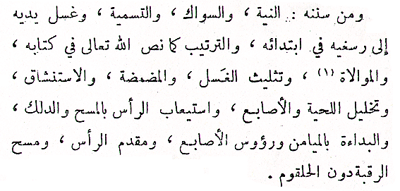
Translation
The sunnan of wudu include:
1) the intention
(niyah)
2) using the tooth-stick (miswak)
3) reciting bismillah before beginning
4) washing both hands up to the wrists before beginning
5) following the order of actions as they were revealed in the verse of
wudu
6) continuity in washing each part
7) washing each part three times
8) gargling water in the throat
9) washing the nasal passages to the soft bone
10) washing the interspaces of the beard and fingers
11) wiping the whole head and rubbing each body part as it is washed
12) beginning with the right, with the tips of the fingers, and with the
front of the head
13) wiping the nape of the neck (without the throat)
Commentary
This sections deals with the sunnan of wudu. The sunnan are defined as
those acts which the Prophet (saw) did regularly. Leaving these acts without
a valid excuse is reprehensible, acting on them results in reward. While
completing the four integrals of wudu renders it complete, enacting the
sunnan perfects the wudu.
The first of these sunnan is making an intention before beginning the wudu. This involves consecrating the act for Allah (swt) alone. Niyah is defined by the Hanafi's as an act of the heart, which need not be articulated on the tongue.
Essentially wudu has two dimensions. The first is its use as a means to enter prayer (because one cannot pray without wudu) and the second as an independent act of worship. Water inherently purifies based on the statement of Allah (swt), "and we revealed from the skies water both pure and purifying," therefore anyone who washes their body parts will attain a state of purification. On the other hand, the reward of a deed is based on one's intention; therefore the niyah is required to earn the rewards associated with this act.
Scenario: If someone regularly takes a shower in the morning such that the four integrals of wudu are completed without an explicit intention, the wudu occurs. The niyah is sunnah (and not mandatory), thus taking a bath without a niyah for wudu renders the wudu valid. However, this wudu will not be rewarded as an act of worship due to the lack of a niyah. The Prophet (saw) stated, "Deeds (are rewarded) according to their niyah."
The second of the sunnan is cleansing the mouth using the tooth-stick. The Prophet (saw) regularly cleansed his blessed mouth with a tooth-stick. In fact, the very last action of the Prophet (saw) before leaving this world was to use the tooth-stick. The Prophet (saw) stated, "If I didn't fear difficultly on my community, I would have ordered them to delay Isha and use the tooth-stick." While brushing with a plastic toothbrush suffices, one can expect increased reward if a wooden tooth-stick is used merely to imitate our beloved Messenger (saw).
The third of the sunnan is beginning with bismillah. Taking the name of Allah (swt) is desirable before beginning any act of merit. In areas where it is not appropriate to take Allah (swt)'s name (e.g. the bathroom), it should either be recited in one's heart or before entering the washroom.
The fourth of the sunnan is washing the hands before beginning. Note the clause of "before beginning." If one is certain that impurity is present on the hands, then washing the hands at the beginning becomes mandatory, otherwise it is a sunnah. Note the distinction between this act and washing the arms, which is the second integral. The second integral includes the hands, but rather than at the beginning, it occurs much later in the wudu.
The fifth of the sunnan is washing the body parts in the order listed in the ayah of wudu. This involves first washing the face, then the arms, then wiping the head, and finally washing the feet.
The sixth sunnah is continuity in washing each body part. This implies washing each part in sequence without unnecessary delay.
Scenario: While performing wudu at work a person may delay washing a body part for a few moments if, for example, he is embarrassed when a coworker enters the washroom. This will result in loss of a sunnah, however, the wudu will still occur.
The seventh sunnah of wudu is washing each part three times. This applies to the body parts which are actually washed, i.e. the face, hands, and feet. The head is to be wiped only once. Three times is established by the sunnah, whereas the mandatory single washing is established by the verse of wudu.
The eighth and ninth sunnan of wudu involve gargling water to the back of the throat and rinsing the nose to its soft bone. Each of these should be preformed three times. While fasting care should be taken that water does not enter the throat accidentally.
The tenth and eleventh sunnan involve wiping between the fingers and the beard, wiping the entire head, and rubbing each body part as it is washed. Each of these is established by the sunnah and each aims to perfect the four mandatory actions of the wudu.
The twelfth sunnah is to begin with the tips of the fingers and toes, the front of the head, and the right. Each of these is established by the sunnah. Abdullah ibn Zaid (ra) related that Prophet (saw) wiped his entire head with his hands; he started with the front of his head then moved to the back and then returned his hands to the front. Furthermore, Aisha (ra) related that the Prophet (saw) loved to begin with the right side while putting on his shoes, straightening his hair, and purifying himself.
The final
sunnah is to wipe the back of the neck without wiping the throat.
Explication
by Shaykh Husain:
Real Audio: Listen
Online | Download
 If
you have any questions on the material covered above, please feel free
to Contact
Us and we will respond shortly.
If
you have any questions on the material covered above, please feel free
to Contact
Us and we will respond shortly.